Digital commons for XR hypermedia 🥽
We connect, and help fund open XR ecosystems 🥦
We support public local-first AR/VR/MR highways , seamlessly connected XR experiences: public XR hypermedia. without obstacles 🈚 like identitystores, appstores, rent-seeking, blockchain-minting etc
We encourage XR translator-development to view existing ecosystems like the 2D web, or file-collections within AR/VR-headsets via open protocols 🔌 : RSS, HTML, JML, Fediverse's ActivityPub and URI's using XR Fragments e.g.
Our mission
, US (DFI), and Canada (DC), narrowed down to OpenSource XR experiences via link traversal.
We support public local-first AR/VR/MR highways , seamlessly connected XR experiences: public XR hypermedia. without obstacles 🈚 like identitystores, appstores, rent-seeking, blockchain-minting etc
We encourage XR translator-development to view existing ecosystems like the 2D web, or file-collections within AR/VR-headsets via open protocols 🔌 : RSS, HTML, JML, Fediverse's ActivityPub and URI's using XR Fragments e.g.
Our mission
to promote the exchange of electronic spatial experiences and all that is related or beneficial to that purpose100% piggybacks NLnet and follows the 'digital for good'-values of Europe values: European Digital Rights and Principles to promote feelgood XR experiences for everybody.
, US (DFI), and Canada (DC), narrowed down to OpenSource XR experiences via link traversal.
Why people want it
The metaverse hype has shown: people prefer using existing 2D ecosystems.
Hence, we promote projecting those as virtual worlds.
In particular, the Fediverse , a fleet of ad-free federated platforms, as backoffice for virtual XR hypermedia experiences.
Federated experiences allow anybody to extend existing open-source foundations and shared data foundations to accelerate XR innovation , by allowing them to "remix" and expand the world .
Byebye constantly reinventing the wheel / walled gardens.
Hello post-scarcity technology.
Hence, we promote projecting those as virtual worlds.
In particular, the Fediverse , a fleet of ad-free federated platforms, as backoffice for virtual XR hypermedia experiences.
Federated experiences allow anybody to extend existing open-source foundations and shared data foundations to accelerate XR innovation , by allowing them to "remix" and expand the world .
Byebye constantly reinventing the wheel / walled gardens.
Hello post-scarcity technology.
"XR hypermedia enables cost-efficient spatial education for societies, and speeds up innovation by hyperlinking XR experiences."
Leon van Kammen / Founder, Strategy Director / @lvk@mastodon.online
XR Digital Commons:
XR Hypermedia criteria
- Local-first
- Secure (read-only & scriptless) content
- Spatial deeplinking
- XR at rest
- No interop-washing
- Credible XR exit
Timeline
-
JanusXR / JML syntax 2013URL-linked virtual worlds (JanusVR) by James McCrae (incl. URL portalsystem). Rebrands in 2020 to (opensource) JanusXR with focus on janusweb. First convincing VR-headset-compatible user-operated spatial web, used by more than thousands of users.
-
SearXR Funded 2020NLnet #NGI #EU funds SearXR an opensource selfhostable meta-searchengine for public URL-based virtual worlds.
-
Facebook rebrand 20218 years after JanusXR, Facebook attempts similar 'metaverse', but proprietary and centralized (rebrands to 'Meta')
-
XR Fragments Funded 2021NLnet #NGI #EU funds XR URI Fragments by Leon van Kammen. Standardisation of spatial anchors in URI's. It got adopted by startups like Alkebulan, and was coincedentally (already) implemented by janusweb (independent simultanious innovation 💡).
-
XRSH funded 2021First ever in-WebXR Terminal running an actual Linux ISO. This researchproject basically brings the opensource linux ecosystem to otherwise closed proprietary headsets. Aerospace engineers have reported to be using it.
-
HAN University collab 2024HAN University uses XR (URL) Fragments while researching VR accessibility. One of the results of this collaboration is the addition of 2-button navigation to the XR Fragments spec.
-
XRForge funding 2025XRForge streamlines the design, collaboration, deployment, hosting, and integration of portable XR experiences - and thus further simplify embedding, cross-platform support and hosting, as well as add vendor specific support.
-
ELFA funding 2025ELFA, a suite of local-first applications with VR/XR integration, got funded by EU's Horizon Europe.
Supporter of Open XR Hypermedia stacks
"(Even after 12 years) I still think Janus had the most right ideas"
Jin / FOSS VR/AR digital artist and advocate
Funding FAQ
Q: Are we talking VC-money?A: Think microgrants / no-cure-no-pay funding of digital commons, think cosmolocalism.
Q: Is it easy to get (my game) funded (made with Unity/Unreal)?
A: Indirectly funding/promoting proprietary engines with public money is tough (public money public code).
Q: Which Open XR engines are preferred?
A: Preferred are Fully Opensource XR Browserengines like: Or roll your own XR hypermedia browser (via XR Fragments e.g.): ♥️ = janusweb has the highest local-first XR hypermedia-support, see translators, polyglot and addressibility and runs on desktop/phone/headset all-at-once.
Contact us in case you've got questions
Q: Regarding hyperlinking, is linking to a webpage enough?
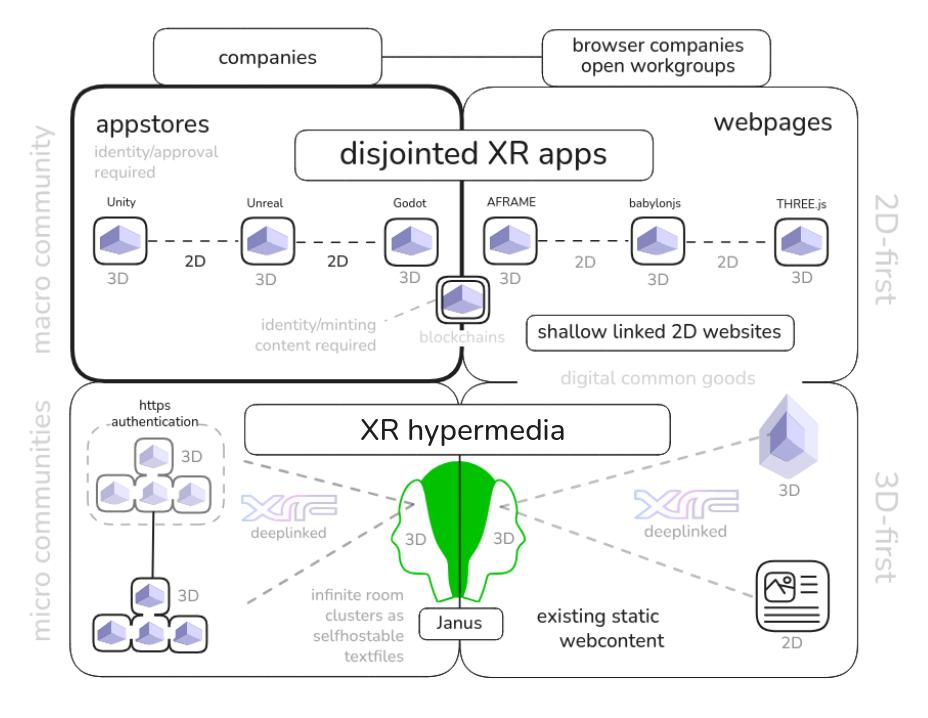
A: Most games or WebXR-sites are shallow-linked disjointed XR experiences via appstores (not hypermedia), basically:
See the difference below:
A: Most games or WebXR-sites are shallow-linked disjointed XR experiences via appstores (not hypermedia), basically:
"We don't want customers to leave our premise"A much more interesting is seamless XR hypermedia surfing: by interlinking 3D files immersively via (XR Fragment) URLs or JanusWeb.
See the difference below:
Rule of thumb: if the XR content can be selfhosted by users separately from the XR viewer, you're on the right track.
Q: How important is security?
A: It depends, The value of a digital common lies in its liquidity. If you wrap public-domain content in restrictive security layers (like heavy DRM or complex access controls), you destroy the "common" aspect. Since the content is meant to be seen and shared, there is no "secret" to protect. Attempts to ensure it isn't maliciously altered are saluted. Scripting languages as part of the content are hypermedia-'killers' as they are a huge attack-vector (eventually turning browsers into a unuseable banking-grade security sandboxes). Open fileformats like `.gltf` and their extensions are at the safest side of the spectrum.
A: It depends, The value of a digital common lies in its liquidity. If you wrap public-domain content in restrictive security layers (like heavy DRM or complex access controls), you destroy the "common" aspect. Since the content is meant to be seen and shared, there is no "secret" to protect. Attempts to ensure it isn't maliciously altered are saluted. Scripting languages as part of the content are hypermedia-'killers' as they are a huge attack-vector (eventually turning browsers into a unuseable banking-grade security sandboxes). Open fileformats like `.gltf` and their extensions are at the safest side of the spectrum.
Q: Crypto?
A: Not really, regarding payments the issues currently are: price volatility and regulatory/AML compliance hurdles. Privacy mechanisms like TALER can be discussed though.
Minting virtual parcels via crypto-transactions: unfortunately this does not qualify as 'local-first', and (un)intentionally enables rentseeking and first-mover-advantage.
Q: How do you identify "XR interoperability-washing"?
A: "XR interoperability-washing" is akin to greenwashing; it occurs when companies aggressively market a commitment to open standards while their top-down corporate structures make true interoperability technically impossible. It also partially explains why XR interop historically creates top-down talkshops, instead of actual bottom-up interop (like JanusXR).
Characteristics:
In contrast, (bottom-up) XR hypermedia offers a more cost-efficient path.
By removing the need to protect stakeholders, centralized user bases, or specific crypto-wallets, it flips the traditional power structure.
In this model, the user—not the corporate stakeholder—is the starting point and operator of the network. NOTE: XRHF is not anti-business, it's just that many online businesses don't have the 90s internet-mindset like DNS-companies (the network is the market, not the users).
A: "XR interoperability-washing" is akin to greenwashing; it occurs when companies aggressively market a commitment to open standards while their top-down corporate structures make true interoperability technically impossible. It also partially explains why XR interop historically creates top-down talkshops, instead of actual bottom-up interop (like JanusXR).
Characteristics:
- Top-down B2B-interop (instead of bottom-up)
- complex SDKs and proprietary integrations
- proprietary servers as essential component
- designed to "lock in" their user base
- no credible exit (run content elsewhere e.g.)
In contrast, (bottom-up) XR hypermedia offers a more cost-efficient path.
By removing the need to protect stakeholders, centralized user bases, or specific crypto-wallets, it flips the traditional power structure.
In this model, the user—not the corporate stakeholder—is the starting point and operator of the network. NOTE: XRHF is not anti-business, it's just that many online businesses don't have the 90s internet-mindset like DNS-companies (the network is the market, not the users).
Q: What is the 'XR at rest' criteria?
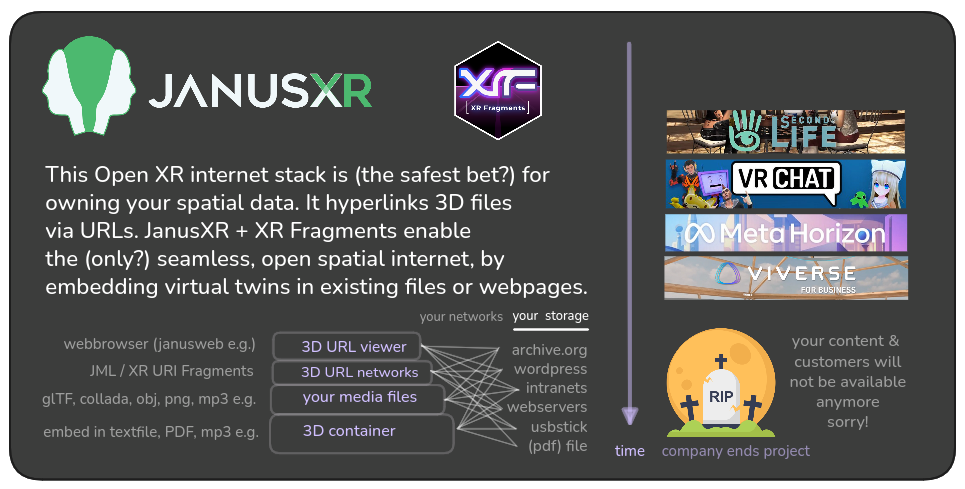
A: Basically that XR experiences should be cheap to archive and reproduce: the 'XR at rest' criteria dictates that immersive experiences should ideally exist as persistent, static files rather than being dependent on active, power-hungry server processes.
By decoupling the XR space from continuous compute requirements, these experiences remain accessible even when the original hosting infrastructure or company servers are powered down.
This approach leverages a 'cacheable' hypermedia architecture, allowing virtual environments to be served and cached much like standard web pages.
Ultimately, this ensures the long-term preservation and interoperability of the spatial web, preventing "digital decay" common in traditional live-service gaming models.
A: Basically that XR experiences should be cheap to archive and reproduce: the 'XR at rest' criteria dictates that immersive experiences should ideally exist as persistent, static files rather than being dependent on active, power-hungry server processes.
By decoupling the XR space from continuous compute requirements, these experiences remain accessible even when the original hosting infrastructure or company servers are powered down.
This approach leverages a 'cacheable' hypermedia architecture, allowing virtual environments to be served and cached much like standard web pages.
Ultimately, this ensures the long-term preservation and interoperability of the spatial web, preventing "digital decay" common in traditional live-service gaming models.
Q: What is the 'credible exit' criteria?
A: A credible exit ensures that users are never trapped within a single ecosystem, allowing their digital identity, assets, and progress to remain functional even if they switch platforms.
By prioritizing data portability and interoperable file standards, developers protect the user's long-term investment and prevent the loss of personal data if a service is discontinued.
Ultimately, providing a clear path to move data elsewhere fosters trust and is a fundamental requirement for building a truly open and decentralized XR landscape.
A: A credible exit ensures that users are never trapped within a single ecosystem, allowing their digital identity, assets, and progress to remain functional even if they switch platforms.
By prioritizing data portability and interoperable file standards, developers protect the user's long-term investment and prevent the loss of personal data if a service is discontinued.
Ultimately, providing a clear path to move data elsewhere fosters trust and is a fundamental requirement for building a truly open and decentralized XR landscape.